Steve Rosenblatt, the son of Johnny Rosenblatt – the former mayor and city councilmember who also played a little baseball and was the namesake for Rosenblatt Stadium – was at Werner Park recently and he spoke with Omaha Baseball 360.
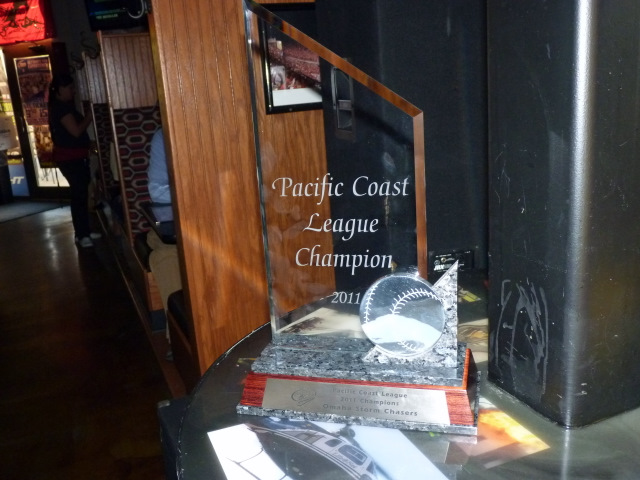
The Omaha Storm Chasers finished off their storybook season by sweeping the Sacramento River Cats in the PCL Championship Series, winning a league championship for the first time since 1990.
On Monday, before the Chasers worked out at Werner Park for the PCL Championship Series, Clint Robinson spoke with Omaha Baseball 360 about his season.
Kila Ka’aihue hit a two-run walkoff home run in the bottom of the tenth inning Saturday to give the Omaha Storm Chasers the Pacific Coast League American Conference Championship.
Lima pitched for the Astros, Tigers, Royals, Dodgers and Mets, compiling an 89-102 record. Most baseball fans will remember him for his colorful personality. He often danced and made all sorts of demonstrative faces as he retired hitters. He loved the game and he loved to compete.
The 37-year-old pitched for the Kansas City Royals in 2003 and 2005.
The Omaha Royals remembered Lima with a moment of silence before their 2-1 victory over Salt Lake this afternoon at Rosenblatt Stadium. After the game, Omaha general manager/vice president Martie Cordaro paid tribute to Lima.
“The baseball world lost one of the true, electrifying players over the last 10 to 15 years,” Cordaro said. “Every fifth day, I know the Astros fans looked forward to ‘Lima Time.’
Lima won 21 games for the Astros in 1999.
“Jose played with a lot of great players down in Houston and he spent two years in our organization – both in Kansas City. I never had a chance to meet Jose Lima. He didn’t play here as an Omaha Royal, but he was definitely one of those players who will be missed in our game.”
The Royals plucked Lima from an independent league in 2003 and inserted him into their starting rotation. His first game was a non-decision, but after that he won his next seven starts in what turned out to be one of the most exciting seasons in Kansas City in a long time – making himself part of Royals folklore.
It’s only mid-May, and as has been the case in so many recent seasons, the 2010 campaign was already beginning to feel like a wash, given that the Royals are 12-23. The team was riding a seven game losing streak going into the game on Thursday against Cleveland. And the Royals recently completed a 3-8 road trip – that didn’t help Hillman’s cause.
At the press conference in which Moore announced the managerial change, he answered the why question.
“Just the overall – just the overall play of our team,” Moore said. “This last road trip obviously was incredibly disappointing. Nobody feels that worse than Trey. And the first couple of games here, back home – it just became evident that we probably needed to move forward and that’s what we decided to do.”
Some fans believe they saw signs of the team quitting on Hillman. Others questioned the way he used his players. And still others scratched their heads over the way he bucked traditional baseball wisdom while also seeming to shun the value of statistics.
In the end, it came down to wins and losses and there just weren’t enough wins.
At the press conference, Moore grew emotional when speaking about Hillman.
“I love Trey Hillman,” Moore said. “I really do. I love him as a – ”
Moore couldn’t finish the sentence without dropping his head slightly and pausing for 27 seconds while attempting to regain his composure.
After Moore’s comments, Hillman chose to address the media – even going so far as to field questions about the game first and then sticking around to answer all of the media’s questions about his firing.
Hillman thanked nearly everybody affiliated with the organization – including the PR staff, the grounds crew, the promotions staff, and the alumni – saying he understands how hungry the community is to see the Royals win and that sometimes difficult decisions need to be made.
I don’t think I’ve ever seen a classier exit in all my years of watching sports – especially from a guy who has been asked to leave.
The thing about being a fan of this game is that it is easy to get caught up in the numbers while forgetting that there are people – good people – who are doing everything they know to do turn those numbers in our favor. Some of the things Dayton Moore said to me last week when I interviewed him in Omaha reminded me of that. Hillman drove the point home again today.
I know that some have mocked Moore’s comments from the interview I did with him when he answered my question about what he meant when he said he wanted to surround himself with people who have a critical eye and not a critical spirit. I found that ironic.
Some even perceived his comments as a swipe at fans, and to some degree I understand why they might think that. Last season, the relationship between Moore and the fans became contentious for several reasons and I think fans had a right to feel slighted. But I think he learned from that. The guy I spoke to last week couldn’t have been more humble.
In reality, Moore wasn’t talking about fans when he answered my question. However, I do think his distinction between a critical eye and a critical spirit probably could apply to and benefit all relationships. Instead he was talking about the need to surround himself with staff who are willing to say what needs to be said for the betterment of the team.
Presumably, that included Trey Hillman. Judging by Moore’s reaction this afternoon at the press conference, I feel safe in making that presumption.
That type of relationship works both ways. And over the past 24 hours, Moore said the hard thing that needed to be said to Hillman. And it did need to be said.
Ultimately though, both men exhibited civility, sportsmanship and common human decency when dealing with one another. And while none of those characteristics guarantee a winning record, I wouldn’t want to be a fan of an organization that wins without those characteristics.
If you were out at Rosenblatt Stadium on Saturday or Sunday, then you probably saw Casey, the Omaha Royals mascot, doing his thing – helping people enjoy the moment by making them laugh.
What you probably don’t know is, the person underneath the fur was 19-year-old Northwest Missouri State University student Andrew Johnson.
Johnson made the drive up I-29 from Kansas City for the weekend with a couple of friends and he knew exactly what he needed to do after donning the Casey costume.
“You walk out there and you’re a source of entertainment,” Johnson said. “One of the neatest aspects for me when I put on a costume – my favorite is doing an appearance as KC Wolf because the [Kansas City] Chiefs have 50 plus years of tradition – and when I put that costume on, I’m the visual representation of the Kansas City Chiefs.
“So, when I walk out there as Casey, I’m representing a great organization here with the Omaha Royals. So, you’ve always got to be on your best behavior and do your best job and have fun. That’s one of my jobs – to keep people in their seats and make sure they’re still smiling.”
In addition to making appearances for the Chiefs, and filling in as Casey, he is a mascot assistant to Sluggerrr, the Kansas City Royals mascot, this summer – which means he helps Sluggerrr prepare for the game and he is the bug inside Sluggerrr’s ear during the game.
“I pick up the hot dogs [that Sluggerrr will be shooting and tossing into the crowd] and get all of his stuff ready for him,” Johnson said “Once we hit game time, I’m making sure he’s in the right spot at the right time. And he’s got a little USB that fits right in his ear,” Johnson said. “I’ve got a big headset and I’m picking up what my boss is telling me in my ear and relaying it to him.”
It wasn’t all that long ago that Johnson was watching Sluggerrr and KC Wolf from afar and dreaming about getting into the business one day. He grew up in the Kansas City area and seeing the mascots perform whet his appetite for the possibility of becoming a mascot one day.
“I watched those excellent characters in Kansas City and saw how much fun they were having,” Johnson said. “I started at my high school, developed that program over a three-year period, and learned that I absolutely loved it.
“During that time I worked with the major league soccer affiliate in Kansas City. There’s an independent baseball team in Kansas City called the T-Bones – I worked with them. And I worked with a bunch of random organizations around Kansas City.
“I either played mascot characters for the teams or if they brought in a random TV show character or something like that, I’d fill in.
“I’ve done a lot and I learned to love it. Over my time in high school, I performed with Sluggerrr and KC Wolf and during that time I got to know the guys, so whenever they needed someone, they would be able to call me.”
The calls came and Johnson is on the road to living his dream – although he probably never envisioned portraying a large blue lion who was surrounded by dogs.
That was the case on Saturday night at Rosenblatt Stadium when the Omaha Royals had a promotion called “Bark in the Park,” in which owners brought their dogs to the stadium and donated a dollar to the Nebraska Humane Society.
“Some of them get really scared, some of them like you, some of them don’t quite know [what to do] – they are kind of like babies,” Johnson said about the dogs. “You just don’t know how they are going to react.”
None of the dogs bit him, but the guy wearing the Herman the Nut costume wasn’t quite so fortunate. “The guy playing Herman said one of the dogs did bite the costume,” Johnson said. “Herman took the blow.”
Beyond all the fun and games, there can be a serious side to playing a mascot. Johnson tells the story about a fellow student at his high school who benefited from getting involved in the school mascot program.
“There was a boy who was in a lot of trouble,” Johnson said. “He was kind of one of those kids who everyone avoids. He had taken an extreme liking to me over the three years I was there. We held tryouts [for the mascot position] at the end of my senior year and he tried out with another boy. We chose the two of them thinking maybe this was what he needed to get out of trouble.
“Over this past year, he’s had fun with it, he’s enjoyed it, and it has kept him out of trouble. It’s been a good opportunity for him to step out of his boundaries and learn something new.”
Johnson’s ultimate goal after graduating from college is landing a full-time gig as a mascot for a professional team. There are a limited number of those positions available, but he’s put himself in a good position to make it happen.
“That’s definitely my dream – to either be in the NFL or Major League Baseball,” Johnson said. “I always tell people the NBA and NHL are a whole lot different, because number one, I can’t skate so that kind of throws that one out, and the NBA – I don’t know if you’ve seen that recent dunk by Bingo with the Milwaukee Bucks, but those guys do crazy stuff. They’re athletes.
“But that’s the goal. I just want to be a mascot.”
Athletes who attend a Division II college on a football scholarship aren’t likely to have visions of playing major league baseball dancing through the heads, even if they do walk on to the baseball team and end up as the starting centerfielder.
But then again, hitting .404 with an on base percentage of .477 – the way Omaha Royals outfielder David Lough (pronounced Low) did during his senior season on the Mercyhurst College (Pa.) baseball team – isn’t all that common either.
Now, as Lough begins his third full season in the minor leagues after being drafted in the 11th round by the Kansas City Royals in 2007, he finds himself one step away from the big leagues after piling up awards and climbing his way up the various prospect lists, including Baseball America – where he is the 10th highest prospect in the organization.
In his first full season (2008) in Class-A Burlington, he ranked in the Midwest League’s top 10 in runs (76), triples (11) and home runs (16). In his second full season (2009), which included stops in both Burlington and Double-A Northwest Arkansas, he hit a combined .325 with 14 HR, 61 RBIs, and 19 SB. As a result he received the George Brett Hitter of the Year Award, was named the Northwest Arkansas player of the year as well as being named a mid-season Carolina League All-Star.
“I’m all about playing the game hard,” Lough said. “I feel like if you play hard, play smart, you do the right things, you take care of your body, [then] things will start turning your way. I felt that, with my hard work and my dedication to the game, and working on the things I need to work on, that I could become a complete player and kind of move up in the system pretty quick.”
As the left-handed hitter continues his quest to become a complete player, Omaha Royals manager Mike Jirschele likes what he sees from Lough, and he likes Lough's chances of playing in Kansas City soon.
“He can run balls down in the outfield,” Jirschele said. “He’s got a strong arm. He can steal bases – that’s one thing he’s working on this year, is trying to steal more bases. He’s had a few where he’s had them stolen this year, but we swung at pitches. So, we’ve got to have the hitter after him be patient too, when he does take a bag – let him take a bag and let him get there, and then drive him in. Overall, I can definitely see him helping our big league club here in the next year or so.”
Defensively, Jirschele says Lough can both, cover, and has the arm, to play all three outfield positions. Other entities, such as Baseball America, say Lough's arm is slightly below average, but accurate.
Lough says he'll play whatever position the club needs him to play.
“I told them I’ll play anywhere – left, center or right,” Lough said. “I like center the best. That was my main position in college and I got adapted to it. But when I started playing left and then right I had no problem switching and moving around.”
Offensively, he’s been a leadoff hitter most of the season so far for Omaha. He got off to a slow start though – mostly falling victim to pitches up out of the strike zone and out of the strike zone in general, but he is learning to adapt to Triple-A pitching and his average is beginning to climb. In his last five games, he is hitting .316 (6-for-19), bringing his season average up to .255.
“In Triple-A, there’s more crafty guys who have been in the big leagues for three or four years who just try to get guys out,” Lough said. “And if they see that you are going to chase one up high or down in the dirt, they’re going to keep throwing you that. You get a reputation for that. You need to be more patient at the plate and show them that you can take those pitches and then hit the pitch that they bring to you.”
Fans with an eye for numbers are usually quick to point out Lough’s poor strikeout to walk ratio (going into this season he had struck out 147 times and walked 63 times), but it’s nothing to worry about according to Greg Schaum, a radio personality in Kansas City who also runs www.royalsprospects.com.
“He’s still learning the game,” Schaum said. “He’s no different than Hilton Richardson [who currently plays for Burlington] or the kid [Rey] Navarro the Royals just got in a trade. The fact is, he’s learning the game and he’s good. He’s figuring it out. He’ll figure out which pitches to stay away from.
“I think he’s definitely the best prospect they have at Triple-A.”
Even though his baseball future looks bright, that didn’t stop him from making good on a promise to his parents to go back and finish his college education at Mercyhurst after the Royals drafted him.
“My parents always thought I should get my education, no matter what,” Lough said. “There are no guarantees in life. Something could tragically happen – hopefully not – but I felt like I wanted to go back and get my education. At the same time, I could work out with the team and the players I played with there and work on staying in shape.”
When Lough is not playing baseball, you’ll probably find him doing something outdoors.
“I like to go skiing, even though that’s kind of a dangerous thing to do,” Lough said. “I like to be outside. I was always like that as a little kid. I like to go hiking and like to play a lot of golf. I do golf right handed though so it doesn’t mess up my swing.”
Kansas City Royals general manager Dayton Moore is in Omaha to watch the Triple-A team play. He answered questions from the press yesterday about Alex Gordon being optioned to Omaha. Then he spoke briefly about the current state of the Royals and the organization’s minor league affiliates.
The first question (and subsequent answer) you see here was asked by another reporter. The rest of the questions and answers were a continuation of the conversation I had with Moore one-on-one in the Omaha Royals dugout on Tuesday afternoon.
Is the organization making a turn around?
Our team is better and our organization is better. You know, three years ago, we had no left-hand pitching prospects in our system. We didn’t have one catching prospect in our system. We have very little speed at all in the organization and as you know, our ballpark demands that if we’re going to be successful, we need speed and athleticism out there. All those components are put in place right now on the minor league level, and it takes time. It’s a process that you go through to get your organization turned around to be successful.
When Terry Ryan took over for the Minnesota Twins in ‘94, they already had a built farm system and six straight years [they had] 87-97 loses and in year seven they were .500. In year eight, they went to the playoffs and won their division, and they already had a farm system that was built. So, not making excuses, [it’s] just the way it is. That’s the way it works in baseball.
We’re never comfortable and satisfied with where we are, but we know we’re better.
Seven of the nine guys in the lineup for Omaha a couple of nights ago are former Northwest Arkansas Naturals. That’s different from what we’ve seen in the past here in Omaha.
That’s a good sign. Last year, our Northwest Arkansas team was comprised of home grown talent. This year it’s the same and hopefully that’s a sign that we’re doing things the right way. That’s not to say that there won’t be gaps from time to time, because there will, but you want the nucleolus of your ballclub to be homegrown players.
And having them come up through the system together – that’s a good thing, right?
Yeah, it is. It is. That’s a good point. You want them to win and play together.
You’ve certainly faced your share of criticism over the past season or two. In your first year, I heard you talk about needing to surround yourself with people who have a critical eye and not a critical spirit. First, explain the difference. Second, tell me what that looks like.
I appreciate you bringing that up. The people who work with me closely are all very outspoken and my management style encourages them to speak their mind.
People with a critical eye – you know that whatever criticism or opinion that they have, you know it’s for the best of the Kansas City Royals; not what’s best for me or them. It’s what’s best for the Kansas City Royals.
People who look at you with a critical spirit – they want you to fail.
They are rooting for it, in a way.
Yeah, they want you to fail.
I want to be the type of person who looks at things with a critical eye and not a critical spirit.
With what we’re doing in Kansas City – we knew what the challenges were going to be – I remind all our people when they come here or to stay here when we’ve extended them to be a part of the organization, this is the toughest challenge in all of sports in my opinion.
Where the Royals were, what we’re trying to do, and the economic conditions of baseball and the challenges – again it’s an eight to ten year deal to try to get this thing turned around. If everything goes perfect, it’s eight to ten years because, you take a guy like [Eric] Hosmer in the draft – it’s three to four years before they get to the major leagues and then it’s another three to four years before they become a good major league player to help your team win.
We’re not perfect people, but the group we have are passionate about getting this thing right in Kansas City.
The year [2006] the Royals took Luke Hochevar in the draft, a guy like Tim Lincecum gets passed up by nine teams and Evan Longoria was passed over by Kansas City and several other teams too. Talk to me about the hit and miss factor of the draft. But also talk about dealing with the signability factor.
Our first draft was 2007. You can look back on the same situation in that draft. [Jason] Heyward is a guy we passed on. [Matt] Wieters and [Rick] Porcello were two guys we couldn’t afford. Our budget was $6.5 million that year. Porcello signed for $7.2 million. Wieters was asking for $10 million and he signed for $6 million. We couldn’t afford them. That’s just the way it is – that’s the structure we’re under. But Heyward signed for $2 million or $2.1 or something like that. We gave [Mike] Moustakas $4 million. But that’s the nature of the draft. Moustakas is going to be a good player.
That’s why you’ve got to stay aggressive. You can’t back off. You just stay aggressive and it’ll work out. We had a good draft in ’08. We had another good draft in ’09. And we expect to have a good draft here in 2010. Internationally we’re being more aggressive. We’re doing some good things. It’s costing us more money than we’d like because of the nature of the bonuses. It only goes so far, but we’re getting our share.
Talk to me about how you view your role as the general manager of the Royals. There is a segment of the fanbase that is quite passionate about the Royals but some of them have grown skeptical in recent years.
I’m very passionate about the Kansas City Royals. They were my boyhood team. I’m very passionate about baseball. I care deeply the people who work with us. I care deeply about the players who commit to be a part of this organization because it’s all about the players at the end of the day.
I’m concerned about the impression that people have about the Kansas City Royals. I want every young boy and every young girl to grow up loving the Kansas City Royals. There is a generation of people who saw nothing but winning and now there’s a generation of people who have seen nothing but losing.
For the baseball family – or that dad or that grandfather who grew up loving the Royals and seeing them perform in all their glory days to now have a grandchild or a son or a great grandson, in some cases, who have never seen the Royals win and they root for the Phillies and they root for the Red Sox and they root for the Yankees because those are the teams that win, or they root for the Braves because those are the teams that have won, it’s got to be in a way – it’s probably not heartbreaking – I probably take it a little more serious than it actually is, but there’s some disappointment.
It’d be no different than, you know – we’re in Nebraska and [having] a family [who loves] the Nebraska Cornhuskers and suddenly somebody’s rooting for KU.
This one had a little of everything – home runs, a Hall of Famer, enthusiastic fans, and a father and son taking in a game for the first time together. All in conditions in which Noah would have felt comfortable.
The Royals scored eleven runs in the first four innings against the Iowa Cubs – who are now managed by Hall of Famer Ryne Sandberg – including a three-run home run by Kila Ka’aihue to right field. Ka’aihue also had an RBI double. Mike Aviles, David Lough, Jai Miller and Scott Thorman also drove in runs.
After the Cubs hit in the sixth inning, the umpires called for a rain delay as the heavens opened up. Thirty minutes later, the game was called, giving Omaha an 11-7 win.
The official attendance was 4,354. Adam and Max Silverman were two of those people.
Adam, 32, decided to bring Max, his two and half year old son, to his first Omaha Royals game on a whim.
Silverman lived in Kansas City until he was 10. That’s when his family moved to Omaha. And while his dad took him to a couple of games at Rosenblatt, he eventually lost interest in the organization as they struggled, but he says he got back into it a couple of years ago.
“The team wasn’t doing well, and I was a teenager and had other things to do and then it started coming time to have kids and I wanted to play ball again and I got back into it,” Silverman said. “And here we are.”
There was so much going on at the game that Max had a hard time concentrating. And you can’t really blame him.
“This one’s losing interest because Billy Butler is not here,” Silverman said about Max. “But we had hot dogs and pretzels and we got our Omaha Royals baseball.”
“I did got pretzels!” said Max as he eyed the concession stands again hoping for another one.
Even though Butler isn’t with Omaha, the Silvermans are following several other players.
“We’re liking the fact that Mike Aviles is here for a little bit longer,” Silverman said. “But Kila’s a favorite. I’m kind of glad that Lough is here this year. He’s starting to impress me a little bit.”
Rosenblatt poses for a picture inside
the stadium named after his father.
(Photo: Lee Warren)
The irony was too rich to miss.
I caught up with Steve Rosenblatt, the son of Johnny Rosenblatt (the stadium’s namesake), on the steps that connect the main concourse at Rosenblatt Stadium to the press box. Media types and stadium personnel often take those steps because the elevator has a reputation for being extremely slow.
Rosenblatt Stadium has been showing her age for quite some time now. That’s just one of the reasons the Royals will be changing venues next season. But the old stadium is still proud enough to host one more season of baseball – one that Steve Rosenblatt plans to enjoy.
He makes his home in Arizona, but he’s planning to spend most of the summer in Omaha. He’s looking forward to spending some time with his grandchildren here in town and he continues to work closely with the ballclub as it makes a transition to the new ballpark in Sarpy County.
“We have some neat things we’re going to do and be a part of,” Rosenblatt said. “The Royals are a great organization. They’ve got great people who are involved in there and whatever I can do to be of help to them, it’s my pleasure.”
So, what was going through his mind tonight as the Royals played their final home opener at the stadium bearing his dad’s name?
“I’ve been lucky enough to be at the first one when I was about 10 years old and here we are 61 years later,” Rosenblatt said. “That tells you a little bit about how long I’ve been around. It’s always a great day when the season opens. This one’s a little bit sad because it’ll be the last one at Rosenblatt, but we’ve recognized for a rather lengthy period of time that eventually, one of these days, it’s going to happen.
“Really, now you’ve got to look to the future – the new Royals ballpark, the new ballpark downtown for the College World Series and understand that they each have a place. My dad would be thrilled to know that Rosenblatt lasted this long.”
He also totally understands why some people along 13th Street still display “Save Rosenblatt” signs in their windows.
“You have to really feel good about people who have that good of a feeling about wanting to keep a facility, but you’ve got to remember there are so many Omahans and so many people who have had great experiences here. That’s one of the reasons I think it was a great thrill for my dad when he was able to help get the ballpark built and when they renamed it after him. I know one of the things he enjoyed the most was the fact that people were there enjoying good baseball and the facility itself.”
Recently, KETV and other news organizations, reported that club officials said the Royals are likely to get a new name next season to go along with the new stadium – allowing fans to have a say in the name. Steve Rosenblatt isn’t involved in that process.
“There are some minor league teams around the country that have duel type names,” Rosenblatt said. “I’ve talked with the Royals about a lot of things, but that’s certainly one that we’ve not discussed and I really think that’s a decision that is on them.”
*****
On the field, the Royals played their final home opener at Rosenblatt, taking on the Memphis Redbirds in front of 6,159 fans. The Royals came out on top, 6-4.
Starting pitcher Gaby Hernandez gave up two home runs to the Redbirds early, but in the third inning Kila Ka’aihue blasted a two-run home run to right field that landed in the upper bleachers, pulling the Royals to within a run. Then in the fourth inning, Jordan Parraz hit his first home run at the Triple-A level to tie the game at 3-3.
The score remained tied until the sixth inning. Memphis reliever Tyler Norrick walked three hitters and gave up an RBI single to Irving Falu. Wilson Betemit sacrificed a run home later in the inning. And Scott Thorman doubled in a run in the seventh inning, making the score 6-3 in favor of Omaha.
Victor Marte pitched two scoreless, hitless innings in relief, picking up the win. Blake Wood, allowed a run in the eighth, but he retired the Redbirds in order in the ninth to pick up the save.
Tomorrow night, the Royals host Memphis at 7:05 pm at Rosenblatt. Omaha sends Philip Humber to the mound against Lance Lynn.
Continuing our “Getting to Know You” series with Omaha Royals’ radio broadcasters Kevin McNabb and Mark Nasser ... we turn our attention to Nasser. (Here's a link if you missed the Q & A with McNabb.)
In addition to being a radio broadcaster with the Omaha Royals since 2001, Nasser is also the director of broadcasting for the team. Before he joined the Royals he called games for the Wilmington (DE) Blue Rocks (Class A), the Portland (ME) Sea Dogs (Double-A) and the Burlington (NC) Indians (Rookie).
“Baseball America” has named you as one of the top ten broadcasters in Minor League baseball. That’s quite an honor. Talk about what went through your mind when you first heard the news.
I thought it was a joke! Who ranks minor league broadcasting prospects? Coupled with the date, April Fool’s Day 2000, it all sounded unbelievable to me. When I found out that the prospect list was legitimate, like anyone in any job, it was flattering to be recognized for what I do.
What is your favorite moment in the broadcast booth since you’ve been with Omaha (can be funny, serious, dramatic, anything that comes to mind)?
My favorite moment was the first time calling play-by-play of a major league game. The Kansas City Royals has been gracious enough to invite me down to call about ten games since I’ve been in Omaha. Knowing how difficult it is to get a big-league play-by-play job, being able to say that I’ve called big league games, with Hall-of-Famer Denny Matthews and Ryan Lefebvre, no less, is an especially gratifying accomplishment.
If it’s strictly related to when I’ve broadcast for the Omaha Royals … Favorites are always tough because you feel bad leaving things out. Kerry Robinson having to leave the game before it started for laughing too hard and Calvin Pickering hitting ten home runs in nineteen at-bats – those were pretty memorable. But from a personal standpoint, Bob Costas unexpectedly joining me in the booth last year while I was in Des Moines, Iowa was my favorite. Costas was in Omaha for the U.S. Olympic swim trials, and he drove over to Des Moines with his son to catch a game. He heard that I went to his alma mater, Syracuse University, and popped in my booth for an inning. Calling a game with him – a person whose work I admired growing up, was a thrill.
Do you have a “most embarrassing moment” in the booth?
My first road broadcast ever in Bluefield, WV in the Appalachian League, I was calling games for the Burlington (NC) Indians. And like many a minor league broadcasters, I described a fly ball to deep left field as a home run – only that it wasn’t. (In fact, the left-fielder played the ricochet off the wall and threw the guy out at second.) It’s happened to just about every broadcaster, so much so, it’s a cliché embarrassing moment. But in the tiny confines of Bluefield press box, the PA announcer, Bud Gallimore, decides that I’m not embarrassed enough with my butchered call. He gets on the public address and tells everyone at the stadium about my call! Thanks Bud.
How much time do you spend preparing to call a game?
It’s an all-day thing. I wake up and spend a couple of hours scouring all the baseball news from the previous night. Then when I go the ballpark in the afternoon, it’s another few hours preparing, talking to players/coaches, and after the game visiting with the coaching staff to review the game. The best part about it, however, is that it doesn’t feel like work because I enjoy it so much.
What do you enjoy most about calling a game?
I enjoy being the fan’s connection to the game.
Name something about your job that the average fan might not know about or expect.
The number one question I get about my job is, “What do I do during the offseason?” I still work for the Royals doing a little bit of everything – marketing, community relations, etc. That surprises most people.
What will you miss most about calling games at Rosenblatt after this season?
There’s no trademark feature that I think I will miss. I think it will be the intangibles of knowing that Rosenblatt has been the home to hall-of-fame players, like Bob Gibson and George Brett, and the site of so many incredible games and moments. That cannot be replaced.
What do you like to do when you aren’t calling games?
All the things I don’t get to do during the season – spend time with family & friends, home-cooked meals and cook outs, reading about other things besides baseball and going to sporting events as a fan.
What are you favorite movies? Books? Bands?
Some of my favorite movies are “The Godfather,” “Pulp Fiction” and “Silence of the Lambs.” For books, “The Catcher in the Rye,” “The Great Gatsby” and “To Kill a Mockingbird.” For music, I’m all over the map – a little bit of Rock (U2, Tom Petty), a little bit of R & B (Michael Jackson, Prince) and a little bit of soul (Marvin Gaye, Stevie Wonder.)
*****
Many thanks to Mark Nasser for taking the time to answer my questions.
If you haven’t listened to a Royals’ broadcast for a while, games can be heard on KOIL-1180 AM and they are also streamed live at oroyals.com. Opening Day is April 8 at 7:05 pm.
With baseball season just about a month away, I thought it would be fun to do a “Getting to Know You” series with Omaha Royals’ radio broadcasters Kevin McNabb and Mark Nasser.
We’ll begin with McNabb. In addition to being a broadcaster, he’s also the director of media relations for the team.
McNabb joined the Omaha Royals in 1994 as the #2 guy to Frank Adkisson who called games from 1994-97. From 1998-2000, McNabb was the director of broadcasting for the team and he called the games solo. In 2001, Nasser joined the organization and McNabb slipped comfortably back into the #2 role. The two of them have been calling games together ever since.
Prior to joining the Omaha Royals, McNabb called games for the Jacksonville Suns (Seattle’s Double-A affiliate at the time) in 1992-93. He was the director of broadcasting for the Columbus (GA) Indians in 1991. And he began his career as a part-time #2 announcer (on weekends) for the Colorado Springs Sky in 1988.
In 2000, you were selected as the play-by-play announcer for the radio broadcast of the Triple-A All-Star Game in Rochester, NY. That must have been a thrill for you. What do you remember about that game? And do you remember who represented the Omaha Royals?
It was an honor and a lot of fun. Anthony Medrano represented the Omaha Royals quite well, going 2-for-3 with a pair of RBI singles as the PCL defeated the IL 8-2. Joe Vitiello, who had played with Omaha from 1994-99, played for the PCL representing Las Vegas in that game and was 3-for-3 with a single, double and triple, scoring three runs. If I remember right, he won the Star of Stars Award.
What is your favorite moment in the broadcast booth since you’ve been with Omaha (can be funny, serious, dramatic, anything that comes to mind)?
It’s a tie. On July 12, 1996, the Royals staged a promotion called “Blast for Cash” Night where if one Omaha batter hit two home runs in the game, five fans would each win $1,000. Ramon Martinez started that game at second base, batting second. He entered the game having hit four homers on the season. In his 12 seasons so far in the big leagues (1998-2009), he has hit a total of 29 round-trippers. But, he must have had his Wheaties that day. His first time up, he hit a two-run shot to left. The Royals batted around in the first inning and he came to the plate again and – you guessed it – he hit a three-run homer to left, probably making him the new favorite player of five fans here.
The next season, on April 17, 1997, Jim Converse and Allen McDill combined to toss a no-hitter, so that was cool too.
Do you have a “most embarrassing moment” in the booth?
I think back in 1991 when I was announcing a game in Columbus, Georgia, I combined phrases to say a reliever was “throwing up” in the bullpen.
How much time do you spend preparing to call a game?
Usually a couple hours. I’d like to do more, but have a lot of other duties here that keep me running around the ballpark most of the afternoon.
What do you enjoy most about calling a game?
Everything. It’s the best part of my job.
Name something about your job that the average fan might not know about or expect.
Either the hours (13-14 per day for night game days), or the fact that we are advertising and ticket sales representatives in the off-season.
What do you like to do when you aren't calling games?
Love to golf. Watching movies is a hobby too.
What are you favorite movies? Books? Bands?
Field of Dreams is #1 (I know, need to diversify). Have to be honest, the only books I read are baseball-related like media guides. As far as music, I really like Green Day, Pearl Jam and Everclear (miss the 90s) and a lot of stuff from the 70s when I was growing up. I used to really get into the local music scene too ... liked Five Story Fall and Anonymous American ... but I’m slowing down now as I get older. Oh, and Martie Cordaro [the vice president and general manager of the team] would kill me if I didn’t say he’s my favorite drummer!
*****
Many thanks to Kevin McNabb for taking the time to answer my questions.
The "Getting to Know You" series will continue with a Q & A interview with Mark Nasser in the days to come.
If you haven’t listened to a Royals’ broadcast for a while, games can be heard on KOIL-1180 AM and they are also streamed live at oroyals.com. Opening Day is April 8 at 7:05 pm.
Various Minor League Baseball teams, including the Omaha Storm Chasers, send Omaha Baseball 360 (as well as other media outlets), game summaries. Those summaries are sometimes tweaked, re-written or published as-is. Other times, game summaries are written from scratch.