Clippers down the Chasers in Triple-A Championship

The Columbus Clippers downed the Omaha Storm Chasers 8-3 in the Triple-A National Championship Game Tuesday night in Albuquerque.

Steve Rosenblatt says his dad would be thrilled with Werner Park

Steve Rosenblatt, the son of Johnny Rosenblatt – the former mayor and city councilmember who also played a little baseball and was the namesake for Rosenblatt Stadium – was at Werner Park recently and he spoke with Omaha Baseball 360.

The Storm Chasers win the PCL Championship

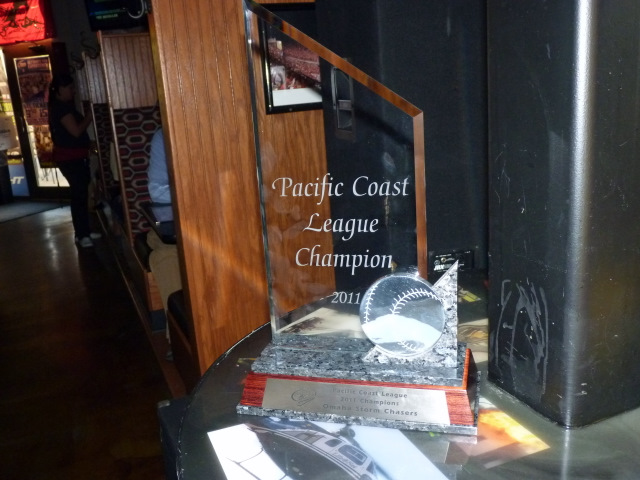
The Omaha Storm Chasers finished off their storybook season by sweeping the Sacramento River Cats in the PCL Championship Series, winning a league championship for the first time since 1990.

Q and A with Clint Robinson

On Monday, before the Chasers worked out at Werner Park for the PCL Championship Series, Clint Robinson spoke with Omaha Baseball 360 about his season.

Omaha wins the PCL American Conference Championship

Kila Ka’aihue hit a two-run walkoff home run in the bottom of the tenth inning Saturday to give the Omaha Storm Chasers the Pacific Coast League American Conference Championship.

Showing posts with label History. Show all posts

Tuesday, September 20, 2011

Steve Rosenblatt says his dad would be thrilled with Werner Park

Steve Rosenblatt poses next to photos of Rosenblatt
Stadium in the Werner Park press box
(Photo: Lee Warren)
History roamed Werner Park recently.

Steve Rosenblatt, the son of Johnny Rosenblatt – the former mayor and city councilmember who also played a little baseball (he once faced Satchel Paige) and was the namesake for Rosenblatt Stadium – was at Werner Park to see the Omaha Storm Chasers take on the Round Rock Express in the PCL American Conference Championship Series.

Johnny died in 1979, but his legacy lives on through his son and through the efforts of the Storm Chasers’ staff, who named the first base concourse at Werner Park, “Rosenblatt Way,” in addition to installing Johnny Rosenblatt Legacy Seats. They’ve also displayed photos of Rosenblatt Stadium in the front office and in the press box.

Thursday, September 1, 2011

Chasers win the PCL American North

The Chasers celebrate after securing the win,
knowing the division title could come later.
(Photo: Minda Haas / Royal Blues)
Omaha, Neb. – Mike Jirschele stood on a folding chair in the clubhouse, surrounded by smiling faces after his team defeated Round Rock and then learned Albuquerque had defeated Memphis, giving Omaha the PCL American North division title.

“First of all, thank you everybody,” Jirschele said. “This is for a great year. I appreciate everything you guys have done. I know some of you hate me, but whatever.”

Cheers and mock jeers filled the room. Celebrations varied throughout the night, but one of the most interesting came from Sean O’Sullivan who performed a Michael Jackson dance exhibition.

“We’ve got a ways to go yet,” Jirschele continued. “We’ve got to be ready for the playoffs. And it’s past curfew, you all owe me a hundred dollars.”

Thursday, June 23, 2011

Reminiscing at the Rosenblatt auction

Cathy and Vic Volkart watched the auction and took
in the sights and sounds for one last time at Rosenblatt.
(Photo: Lee Warren)
Everything felt out of sorts at Rosenblatt Stadium today – from the security fence, to the lack of activity inside the gates to the weather.

On a cloudy, dreary, unseasonably cool day in June, baseball fans didn’t hear the ping of aluminum bats as they’ve grown accustomed to at this time of year. Instead, they heard auctioneers encouraging them to take a piece of Rosenblatt home with them.

Auction Solutions, Inc., the entity in charge of the auction, provided a 35-page catalog filled with items fans could bid on.

Wednesday, May 25, 2011

Remembering Paul Splittorff

If you look closely, you can
see Splittorff's autograph
I received a nice email from a Royals fan this morning after news broke about Paul Splittorff’s death. He echoed what we’re all feeling today, saying it is a sad day in Royals land.

“His autograph is on a ball no more than five feet from me now,” he said. “Had it signed, along with several other O-Royals players at the time, when they had a meet and greet, probably around '70. I remember my mother taking me. I would have been around seven at the time.

“Included in several of the emails I received this morning was the interview you did with him in Sept. of last year. Great interview and his genuine love for the organization really comes out during it. I had tears flowing both times I watched it.”

Here’s the video interview:

Monday, May 23, 2011

Mike Jirschele wins his 1,000th career game as a manager

Photo: Andrea Stava / Omaha Storm Chasers
He had to wait for a while to get it, but Mike Jirschele won his 1000th game as a professional manager Monday night when the Omaha Storm Chasers defeated the Tucson Padres 2-1, thanks in part to a strong pitching effort from starter Kevin Pucetas (1 ER in 7.0 IP) and an outstanding effort from reliever Mario Santiago (0 ER in 2.0 IP).

Jirschele sounded more relieved than happy after the game.

“I’m just happy it’s over because we’ve been waiting for a while for this one,” Jirschele said. “I just wanted to get it out of the way. In fact, I didn’t even know I was that close to a thousand until we were on that last road trip and Mark Nasser, the radio guy, said, ‘Do you know what win that was? 999.’ I had no idea.

“You know, to me that doesn’t mean anything. Yeah, you won a thousand games, but I don’t win the games anyway. Those guys out there playing are the ones that win the games.”

Thursday, May 19, 2011

Johnny Rodgers and Steve Rosenblatt make an appearance

Johnny "The Jet" Rodgers prepares to throw one of the
ceremonial first pitches at Werner Park.
Mike Moustakas is starting to make a habit out of playing catch with kids at Werner Park before games. Tonight, there was a little league team on the field for the pre-game ceremonies and Moose took turns playing catch with several of them.

*****

Johnny “The Jet” Rodgers threw out one of the ceremonial first pitches. This was his first time at Werner Park. He said they had to give him directions to find the stadium.

The 1972 Heisman Trophy winner spent some time warming up before he took the mound. Afterward, he appeared to be pretty happy about getting the ball to the plate.

“I’m impressed that I was able to make it to the catcher after all these years,” the 59-year-old said. “They always remember if it bounces.”

Saturday, April 16, 2011

Historic night at Werner Park ends with a Storm Chaser victory

George Brett, Bob Gibson and Jeff Suppan chat in the
Storm Chasers' dugout before the game.
The Omaha Storm Chasers got a strong effort from their starting pitcher Danny Duffy and got just enough offense to win their inaugural game at Werner Park 2-1 against Nashville in front of 6,533 fans.

Duffy was on a strict pitch count limit (he threw 76 pitches), so he had to be removed one out shy of qualifying for the win (he pitched 4.2 innings). His final line was impressive though: 1 H, 0 ER, 1 BB and 7 Ks.

Everett Teaford, Luis Mendoza, Blaine Hardy, Jesse Chavez and Luis Coleman combined to only allow one earned run over the final 4.1 innings. Chavez got the win. Coleman picked up the save.

Wednesday, March 9, 2011

Jesse Cuevas spends one final day at Rosenblatt Stadium

Cuevas speaks to the crowd at Rosenblatt Stadium after
the final Omaha Royals' game there on September 2, 2010.
The Omaha Storm Chasers sent out the following press release today about former Rosenblatt Stadium groundskeeper Jesse Cuevas:

*****

Cuevas Spends Last Day at Rosenblatt, Honored at Werner Park

Longtime groundskeeper will see his name adorned on a single-game suite at the new ballpark

PAPILLION, NE – Jesse Cuevas, one of the most well-known baseball figures in Omaha, spent his last day at Rosenblatt Stadium Wednesday, ending a 41-year run as an employee at the ballpark. To honor Cuevas, the Omaha Storm Chasers have announced that one of their new suites at Werner Park will bear the longtime groundskeeper’s name.

Sunday, March 6, 2011

Several thousand get a sneak peek at Werner Park

The work at Werner Park is estimated to be 90-95% complete
An estimated crowd of 3,000 people braved 30 degree temperatures to take advantage of the Werner Park Sneak Peak from 9:00 am - 2:00 pm Saturday.

Storm Chaser fans went out in groups of 25 on 20-minute tours of the park. They had a chance to see the video board going up, to visit the various suites, to hear about the nuances of the park and to ask questions.

Everything might be new, but the Storm Chasers plan to keep strong ties to the past.

Friday, March 4, 2011

"The Road to Omaha" sculpture removed from Rosenblatt

"The Road to Omaha" sculpture as it appeared on
December 17, 2010 -- the day the Storm Chasers moved
from Rosenblatt Stadium to Werner Park
It seems as if "The Road to Omaha" sculpture has been perched outside Rosenblatt Stadium for decades, but in reality, it was placed there in 1999.

Yesterday it was moved from Rosenblatt and taken to a "secret storage facility." It will be restored and installed at TD Ameritrade Park in time for the 2011 College World Series.

The sculpture has served as a gathering place for baseball fans as well as a back backdrop for many photos over the years.

The Omaha World Herald was on site as the sculpture was taken from Rosenblatt. Here is the video they shot:

Saturday, December 11, 2010

‘Time in the Minors’ gives fans an intimate view of minor league baseball

All 1,500 players who are drafted each year out of high school or college dream about making it to the major leagues. Sandwiched between the dream and the possible realization of it are injuries, slumps, hot steaks, adjustments or a lack thereof, the mental aspect of the game and low pay. And then there are the uncontrollables – the personnel moves, playing time and timing.

Tony Okun, who grew up in Omaha watching the Omaha Royals play and now lives in Idaho, gives us a glimpse of the entire journey through the eyes of two players who come from different perspectives in his “Time in the Minors” documentary distributed by Landmark Media.

Tony Schrager, a 28-year-old infielder who was born in Omaha, played for Omaha Westside, and went on to play at Rosenblatt Stadium in the 1997 College World Series for Stanford. The Chicago Cubs drafted him in the 6th round in 1998 and sent him to play in A-ball. Schrager got an $87,500 signing bonus, plus $20,000 to finish school and he was paid $850.00 a month in A-ball, minus expenses.

John Drennen, an 18-year-old highly touted outfielder, received a $1 million signing bonus out of high school with the Cleveland Indians after being selected as a sandwich pick in the 2005 draft. He started in rookie ball, making $1,175 per month.

The documentary weaves back and forth as their stories progress during the 2005 and 2006 seasons, taking viewers into the locker room, weight room and family room of each player. Okun interviews their current and former coaches, scouts and teammates. As you watch, the tension builds, making you wonder if either of them will see their dream realized.

“This isn’t a glamorous story,” Okun said in a phone interview. “It’s hard. It shows the challenge that they go through and that’s exactly what I wanted to do. I wanted to just go from A to B and show you what these guys go through. And I hope you walk away from it with a newfound perspective or respect for these kids playing in the minor leagues.”

Okun shows how important timing can be as minor leaguers chase their dream. At one point, just as Schrager is positioned to get a call to the major leagues, he goes into a slump. In another scene, Drennen gets a chance to face Roger Clemens in a minor league game, shortly after Clemens came out of retirement in 2006 to pitch for the Houston Astros. Clemens hung a 2-2 splitter that Drennen hammered over the right field wall.

Eventually, Schrager found himself out of affiliated baseball in an independent league, and you can feel the feel the pressure he is under as he talks about it.

“I wasn’t ready to say that my career was over in affiliated baseball,” Schrager says in the film. “This is really the only way for me to get back in it. Even if I go out here and have a great year, there’s no guarantee. I could have the best year of my career here and there’s no guarantee that somebody’s going to pick me up.”

The DVD is available in two lengths – a 60 minute version or an 85-minute version, the latter of which includes footage Okun shot in Omaha at Rosenblatt Stadium when Albuquerque visited Omaha for a series in 2006. Schrager played for Albuquerque at the time

“It was real special, walking up on those old, slick, metal risers again,” Okun said. “It was bringing back memories from my childhood. I thought it was very special – Tony coming back to his hometown.

“It was great. It was nothing but a wonderful experience. I really enjoyed it. I actually caught a foul ball. I was up with the other videographers and a ball comes screaming up toward me and I caught it. I got a nice ovation from the crowd. It was really funny and I have the ball in a box of stuff I collected while shooting the film.”

The longer version of the film contains portions of a radio interview Schrager did with Mark Nasser, who has been calling Omaha Royals’, now Storm Chasers’, games since 2001. Schrager says during the interview that one of the first things he did after he learned he’d be playing for Albuquerque was to look at the schedule to see if they would be playing in Omaha.

If you are interested in picking up a copy of the DVD, you can find out more by going to the Oh! Show Productions website. Here’s a trailer of the film:

Monday, November 22, 2010

Memories are flowing for Steve Rosenblatt

Steve Rosenblatt signs autographs at Rosenblatt in August.
As the Omaha Royals’ 2010 season drew to a close, Steve Rosenblatt continued to frequent the stadium named after his father. He fielded questions from reporters who were wondering what he was feeling as the era of stadiums being named after people rather than corporations was drawing to a close.

One particular night, he told a couple of us he thought the gravity of the situation would hit him as the final seconds of the final UFL game played at the stadium ticked off the clock. That night is coming soon. The UFL Championship Game will be played on Saturday at Rosenblatt and then the stadium will go dark for the final time.

The UFL Championship Game is a new wrinkle. Rosenblatt planned to head home to Phoenix on Friday since the final Omaha Nighthawks game has already been played. But he changed his plane reservations to stay in town for the championship game.

“I really feel, kind of inwardly, that having been there, and having been a bat boy at the first game ever played there, I certainly wanted to be there for the last sporting event,” Rosenblatt said in a phone interview this past weekend. “It’ll rev my memory up a little bit.”

Having his memory revved up has been happening a lot lately. In September, when the Omaha Royals’ played their final game at Rosenblatt, he went down onto the field for one final hit. He told the fans if he hit one that Johnny Rosenblatt would be proud of, he would turn around, give the thumbs up and the fireworks would begin.

So, what was he thinking that night as he stood at the plate?

“It’s over,” Rosenblatt said. “It’ll probably be the last time in my life I ever hit a baseball. Of course, at 72 years old I probably should have stopped about 30 years ago.

“We had a lot of fun that night. It was a great evening. As difficult as it was, I got a big kick out of it because, you know, my daughter did the national anthem and she did a great job – I think she over shone my hitting ability – and we had a lot of Rosenblatt people in town. It was the first time I’ve ever got together with my other three cousins named Rosenblatt – all four of us together. They are of course, Johnny’s nephews. It was a sad but neat evening.”

Tom Kelly was the man who threw batting practice pitches to him that night. Kelly is the grandson of Tommy Kelly, the man who threw the first pitch ever at Rosenblatt in October, 1948 – the night Steve was a batboy in the third base dugout.

“I didn’t want to disappoint the fans. I think I hit a couple halfway decent. But it brought back a lot of memories because I had several at bats there when I was playing many, many years ago when I probably could swing a little better. It was almost like every pitch, I was thinking about something other than hitting the baseball.”

How could he do anything but remember? He’s a walking baseball encyclopedia. He tells one story that connects Rourke Park, the stadium that used to stand on 13th and Vinton before it burned down in 1936, with Municipal Stadium, which would eventually become Rosenblatt Stadium. He says Satchel Paige pitched in both ballparks.

But the memory doesn’t end there.

“In 1951 or 52, the [Kansas City] Monarchs came through here and played a game in the Negro American League,” Rosenblatt said. “I think my dad may have been involved in setting the game up – he was running the stadium at the time. His job was the city commissioner.

“We get to the game. I’m probably 13 or 14 years old and we walk into the stadium and my dad says to me, ‘Steve, you’re upstairs on the PA. You’re doing the public address.’ I said, ‘What?’ So, I’m doing what Bill Jensen [the current PA announcer] does, except I’m 14. So here I go upstairs and pitching for the Monarchs is Satchel Paige.

“He was in the big leagues I think in 48, 49 and 50 with Cleveland. He has this thing called the ‘hesitation pitch’ and he used it on a number of occasions during that game, which was the most memorable thing to me. It was mind boggling to see anybody do what he could do.”

Rosenblatt describes the hesitation pitch in detail.

“Most people in that day – including myself, because I was pitching a little bit at that time – had kind of a rocking chair windup. They’d have the ball in front of them. They’d bring their hands down, come back up over their head, using lots of energy the pitchers today don’t use.

“So, he’d do that and then he’d go up on his right foot and he’d come down on his left foot, but when he came down on his left foot, he didn’t throw. So the batter sees him coming forward and his weight begins to shift because you’ve only got a microsecond and his weight is slightly transferred but Paige still hadn’t thrown the ball yet.

“Then, he’d turn loose about a 92 mph fastball from that position and he’d catch the hitter literally flatfooted. You’d think, ‘How in the world would you get any power on a baseball that way?’ but he had that kind of a whip, lean body that was very flexible.”

The Satchel Paige connection doesn’t end there.

In 1935 or 36, Rosenblatt says that during the AAU semi-pro tournament in Wichita, Johnny Rosenblatt played for the Nebraska team and they went up against a team from North Dakota that Satchel Paige played for at the time.

“My dad gets up to hit against him and Paige gets two strikes on him,” Rosenblatt said. “The catcher threw the ball back to Paige, Paige grabs the ball, walks halfway to home plate and he says to my dad, ‘You won’t see the next one.’”

“He walked back to the mound, made his pitch, Johnny swung and his comment in the Wichita paper was, ‘Never saw it.’”

On September 2, 2010, some 75 years later, Steve Rosenblatt made his way to home plate for what would be the final at bat ever at the stadium.

He attempted a few bunts, then he began to swing. He made contact on a couple and he swung and missed a couple. The crowed urged him on – video cameras running, anticipation building. After making good contact on a ball he pulled toward third base, he figured that was good enough for Johnny, so up went his thumb, and down went the lights.
Friday, November 19, 2010

Q & A with Jerry Cram

You don’t have to dig deep into the Omaha Royals’ record book to find Jerry Cram’s name. The right-hander, who pitched for Omaha from 1969-1972 and 76-81, sits on top of the all-time wins list (61), games pitched (314) and strikeouts (586).  He’s also second all-time in saves (37).

In 15 minor league seasons, he posted a 107-74 record with a 3.26 ERA and 1.27 WHIP. He never got much of a look at the big league level though. In 23 big league appearances spread out over four seasons, he was 0-3 with a 2.98 ERA and a 1.34 WHIP. But he’s a fixture in Omaha Royals’ history.

As Omaha’s 2010 season was winding to a close, I caught up with Cram and had a brief conversation with him at the 1970 Team Championship Dinner at Rosenblatt Stadium.

What do you remember about the 1970 championship season?

We won the championship in ’69. It was my first chance to play in Triple-A. I almost made the big league club that year and then having to come back was like, “Okay, work hard, do this, do that,” but we had such a great bunch of guys and whenever you can win something back to back, no matter where you’re at – it was a great accomplishment.

What do you remember about Rosenblatt Stadium?

Shakey’s Banjo Band played between innings and there’s not going to be too many people who remember that part of it.

But it wasn’t built up. It was just the one section. The ball still kind of flew out of here. Left-handed hitters struggled to hit balls out of here. You could never hit a ball to straightaway centerfield. It was definitely a pitcher’s park, but we played a very, very good brand of baseball.

Jack McKeon [who was the manager at the time] was just talking about how you guys struggled to hit .500 in 1970, and how, after you finally hit that, your team took off. Do you remember that stretch of games where you got to .500 and took off?

Well, there’s been a lot of games since then. I probably don’t remember that stretch. But that’s usually what happens. When a team wins, say 10 games in a row, then it kind of catapults you right on by and you just keep right on going.

Talk about the group of guys you played with in 1970 and the influence they had on your career.

I played with a lot of older guys and I learned a lot of things from them. We didn’t have coaches. We just had McKeon as the manager. We didn’t have a hitting guy. We didn’t have a pitching guy who stayed with us like they have today.

Tuesday, November 16, 2010

Triple-A team is now the Omaha Storm Chasers

Courtesy: Storm Chasers
The Omaha Royals announced their new team name yesterday at the Embassy Suites – La Vista in front of more than 1,000 fans. They are now the Omaha Storm Chasers. The new name was chosen by fans from among the nine most popular options.

“The team name recognizes the importance of weather in the metro area and across the state,” said Martie Cordaro, vice president and general manager of the team. “It also, in a whimsical way, pokes a little fun at the variety of weather we experience here.”

The team will have two new mascots for the 2011 season – Stormy and Vortex. Casey will also be returning. The team will have a new logo and uniforms as well. But it won’t be out with the old and in with the new entirely.
Vortex

Stormy
“We’re still the same front office staff,” Cordaro said. “We’re still going to be the same entertainment option that we have been. We’re only going to do it in a facility that is amenity appropriate for minor league baseball.

“Nine thousand total capacity – 6,500 fixed seats versus the 24,000 that we had. I think that’s the biggest change. Yes, geographic location has changed, but Sarpy County should be commended for keeping Triple-A baseball in the metro because if they didn’t do it, Triple-A baseball wouldn’t be playing anywhere else here.”

With the exception of a three-year period, the team has been known as the Omaha Royals for four decades. One of the biggest challenges in changing the team name is going to be brand identity – especially among people who enjoy the baseball experience while not necessarily following the box scores on a regular basis. The front office seems confident that they are up to the challenge.

“We’re going to do a very good job of making sure that the relationship between Omaha and Kansas City remains constant,” said Alan Stein, president of the Storm Chasers. “We’re going to put a patch on our shoulders. We’re going to do all of the little things with our affiliates’ stamp that we can. We’re going to sell more baseball than what we have in the past.

“Beyond that, we are very comfortable that as the Triple-A club in this market, we’re going to be everywhere with this new brand and when folks get out to the new ballpark and see how great that is, we don’t think there is going to be any issues at all with the transition of the brand.

“Then when you throw on top of that what a good brand this is all by itself – all of the things we’re going to be able to do in schools with kids and math and science and technology and all of the fun play on words that we’ll be able to use with Storm Chasers, and the fact that, according to our research, more people said weather was the one thing they identified themselves with in Omaha [more] than anything else. They said transportation, agriculture, philanthropy and weather. We knew we were on the right track.”

The Storm Chasers will begin play at the newly named Werner Park in Sarpy County on April 15, 2011.

In other news, Bill Jensen, the PA announcer at Rosenblatt Stadium for the past 20 years, will return for the 2011 season for both the Omaha Storm Chasers and the College World Series.

*****
Omaha Storm Chasers' GM Martie Cordaro makes the announcement about the new team name on November 15, 2010:


Saturday, October 30, 2010

New team name to be unveiled November 15

The Omaha Royals will unveil the results of their Name the Team contest during an event on Monday, November 15 at 5:00 pm at Embassy Suites – LaVista.


The new team name will be one of the following nine, chosen by fans who had a chance to vote on the Royals’ website recently for their favorite:
  • Cattlemen: Presumably a tribute to people across the state who raise cattle.
  • Commanders: A tribute to the military personnel in the area.
  • Force: Just a cool name?
  • Hailstorm: A reference to the stormy nature of the area.
  • Omahogs: Omaha had a minor league team named the Omahogs that played in the late 1800s in the Western Association and Western League.
  • Royals: The current team name remains on the table.
  • Sodbusters: A tribute to the farmers of the area.
  • Storm Chasers: Another weather reference.
  • Windwalkers: Seems to have something to do with ranching and/or expeditions.
In addition to announcing the new team name, the team will also unveil the new mascot, logos and uniforms at the event. Food, games for kids, face painting and clowns will be available.
The event is open to the public. If you would like to attend, you must RSVP by November 5 to Kay Besta or Lois Biggs at 402.734.2550 or rsvp@oroyals.com.

Tuesday, August 24, 2010

5 reasons to keep the Omaha Royals' name

(Casey posses with fans.)
Fans of the Omaha Royals have until September 6 to visit the team's website to submit their team name ideas for the 2011 season and beyond. Omaha will begin playing in their new Sarpy County ballpark next season making this a good time to consider a name change if one is going to be made.

Club officials say the “Omaha” portion of the team name will continue. They are seeking fan feedback regarding the second portion of the team name. Fans can submit "Royals” if they want the team name to remain the same.

On September 13, the Royals will release the top 24 names submitted and from September 13 through September 27 the public will be able to vote on their three favorite names. On October 4, the team will release a list of the top nine team names remaining under consideration and fans will get to vote for the one name they prefer.

Then in November, the team will announce their team name, mascot, logos and uniforms at an event that will be open to the public.

“We encourage everybody in the metro area to take part in this process and help decide the name of Omaha’s Triple-A baseball team, as we enter the exciting new era of moving into a state-of-the art Minor League ballpark,” said Royals Vice President/General Manager Martie Cordaro. “Our owners, management and staff all value our fans’ opinions and feelings and are excited to include them in the process of selecting a team name.”

Now that you know all the details, allow me to make a case for keeping the team name the same:

1. The Omaha Royals’ team name is rich in tradition. My mom took me to Omaha Royals games when I was a young boy. I bet your parents did too. Now we are taking our children to Omaha Royals games. Let’s give our kids a chance to do the same thing.

2. Omaha has one of the longest running affiliations in baseball with its parent club. Keeping the team name as the Omaha Royals is the perfect way to honor that affiliation. If the affiliation with Kansas City ever does end, then a new team name can be considered.

3. Regardless of where you stood on the issue of moving to a new stadium, keeping the Omaha Royals’ team name is the perfect way to hang on to tradition. How cool would it be to sit in the new ballpark in Sarpy County while watching the Omaha Royals play and still be able to talk about names such as George Brett, Willie Wilson, Frank White, Mark Gubicza, Paul Splittorff, Jerry Cram, Fran Healy and so many others who wore the Omaha Royals’ uniform?

4. The Omaha Royals’ team name is an established brand. I run into people on a weekly basis who still have no idea the team will be playing in a new stadium next season. They are nominal baseball fans who recognize the current team name. They would probably not recognize a new team name and therefore may have no connection with the team in 2011.

5. We’ve tried to change the team name in the past and it was a complete failure. Remember the Omaha Golden Spikes fiasco (1999-2001)?

Saturday, August 21, 2010

Jack McKeon reminisces about his days as manager of the Omaha Royals

Jack McKeon (Photo: Stan Hall)
You might think winning the 1970 Championship as the manager of the Omaha Royals would rank pretty far down the list of accomplishments on Jack McKeon’s resume considering he went on to manage the 2003 Florida Marlins to the World Series title, was twice named the NL manager of the year (1999 and 2003) and managed some 15 years at the big league level with stops in Kansas City (1973-75), Oakland (1977-78), San Diego (1988-90), Cincinnati (1997-2000) and Florida (2003-05).

But McKeon holds the 1970 title in high esteem.

“You’ve gotta look back at my career and say number one is winning the World Series in 2003,” said McKeon, who was at Rosenblatt last night for a dinner honoring the 1970 Championship team. “Number two was in 1999 when I was manager of the year in Cincinnati and we won 96 games and didn’t make the playoffs. And I think after that, number three would be the 1970 team in Omaha.”

McKeon reminisced about that team with the media.

“In ‘70 we started off very slow,” McKeon said. “We had such good, resilient players and despite being out of first place by 10 or 12 games on July the 6th, we came back and won the thing. That’s why I always have fond memories of the ‘70 team. They were like biscuits. You know, when things got hot, they rose to the occasion.”

He didn’t need much prompting to continue talking about the team.

“The ’70 team was special. We never got to .500 until August 1 that year and I kept preaching to the players about the fact that, ‘Hey, get to .500 and we’ll roll.’ Well, you know, I was trying to be politically correct and trying to be optimistic and maybe deep in my heart I didn’t believe it, but I was trying to sell them guys and trying to motivate them. But we got to .500 on August 1st. From August the 1st on, I think we won like 26 out of the next 34 games and ended up winning the pennant by two or three or four games.”

McKeon’s memory is spot on. The Royals went 73-65 in 1970 and went on to win the East Division of the American Association by three games over the Iowa Oaks. Then they went on to defeat the Denver Bears four games to one to win the championship. The 1970 title was the second one for Omaha in just its second year of existence.

Was there one particular moment that turned the season?

“We struggled early in the year and I made a call to Kansas City and I said, ‘Look, we’ve got a bunch of old guys here that can’t play. Let’s get them out of here and bring some young kids in.’ That’s when we brought in the Lloyd Gladdens, the Jim Yorks, and a Charlie Days, and [Ted] Parks at third base. We brought some of those young players in and they kind of sparked us and, you know, we just started to roll.”

The 1970 season wasn’t the first time McKeon pleaded for younger players in Omaha. He recalled his battle to get young players up with the 1969 team too.

“I remember Paul Splittorff as a young kid having a very good Spring Training,” McKeon said. “And the director of player development, Charlie Metro, I saw him in Spring Training, and I said, ‘I’d like to have him [Splittorff], and Jerry Cram and Al Fitzmorris in Omaha – three young kids and they said, ‘Ah, you can’t have those guys. They’re too young. They’re not ready. You’ll ruin ‘em. They’re over their heads.’

“I kept pleading and pleading and finally they gave in and I remember Charlie Metro telling me, ‘Don’t you come complaining to me in about mid-May or June that these guys can’t cut it.’ I said, ‘Don’t worry about it, I’ll take care of ‘em.’ Well, the rest is history. Each one of them won anywhere from 10 to 13 games that year and we won the pennant by about six or seven games.”

Again, his memory is right on. The Omaha Royals won the pennant by six games over the Tulsa Oilers in 1969. Splittorff won 12 games that season; Cram won 10; and Fitzmorris won 10.

So, does McKeon ever think about those formative years at the beginning of the organization and the role he played in the success of the organization later in the decade?

“Oh yeah,” McKeon said. “The good thing about not only managing the Royals here in Omaha was the fact that I managed the instructional league team as well. And that gave me an advantage to teach my system – not only to the players in Omaha, but they knew it before they got to Omaha. So, when I became the manager in Kansas City, all these players that graduated up there with me, they knew how to play the game. And fortunately, we had some successful years in Kansas City.”

Saturday, July 17, 2010

Making memories at Rosenblatt Stadium

August 10, 1981 was an eventful day in baseball.

Kansas City played their first game on that date after the 1981 strike ended. Cal Ripken, Jr. made his Major League debut against the Royals that day – coming into the game as a pinch-runner for Ken Singleton in the bottom of the 12th inning and scoring the winning run.

George Brett appeared on the cover of Sports Illustrated with Mike Schmidt (they were the reigning MVPs at the time) under the banner “Here We Go Again!”

Pete Rose recorded his 3,631th career hit, breaking Stan Musial’s NL hit record.

And, while all of that was going on, I attended an Omaha Royals baseball game at Rosenblatt Stadium with my best friend’s family. It turned out to be quite a day.

I can’t remember how we found out, but when my best friend and I heard that Mickey Mantle was in the stadium and he was signing autographs, we scrambled to find him. It wasn’t that hard because he was seated behind home plate, a little toward first base, and a line of kids was forming up the aisle.

I was only 14 at the time and had no real understanding about Mantle’s relevance to the game. In fact, as a Royals fan, I couldn’t stand the Yankees. But somehow I knew Mantle’s name was bigger than the rivalry. So I got in line with my friend.

Mantle signed a sheet of paper for me (why didn’t I have him sign a ball?), I added the date, folded it, and stuck it in my pocket. When I got home, I had enough sense to remove it and place it in plastic. Although, for some bizarre reason, I colored in the date with a pen (see the photo).

I cannot remember who the Omaha Royals played that day. In fact, I cannot even find a box score online for that particular game. Thanks to Baseball-Reference, I can see that guys like Onix Concepcion, Ron Johnson, Darryl Motley, Ken Phelps, Bombo Rivera, Pat Sheridan, Don Slaught, Jerry Cram, Atlee Hammaker and Mike Jones played for the O. Royals in 1981. But as for the game itself, I cannot remember a thing.

What I do remember is a brief encounter with Mickey Mantle at Rosenblatt Stadium with my best friend by my side.

The Omaha Royals have 25 regular season home games remaining at Rosenblatt Stadium. General manager Martie Cordaro and his staff have promotions planned nearly every one of those nights.

Players often take time to sign autographs. Casey and the other mascots roam the stands. There are planned giveaways, fireworks, concerts after games, a night dedicated to honor the 1970 championship team (August 21), and the team is playing pretty good baseball right now – they are just 0.5 games out of first place in the PCL American North division.

Pick a night or two, bring your family out to the ballpark, and make a memory – one that maybe they’ll be talking about some 29 years later.

Saturday, July 3, 2010

Local actor reenacts Lou Gehrig's speech at Rosenblatt

Actor Kevin Ehrhart portrayed Lou Gehrig
After reenacting Lou Gehrig’s famous “luckiest man” speech at Rosenblatt Stadium last night for the ALS Association, actor Kevin Ehrhart – who was donating his time for the event – exited the field behind home plate and walked up the steps to the main concourse. Fans high-fived him as he went and one woman stopped him with tears in her eyes to thank him.

His work with kids at the Rose Theater was his motivating factor for donating his time to give the speech.

“I’ve been an actor with the Rose Theater for 22 years and I just worked with kids, you know, I’ve spent my entire career doing that,” Ehrhart said. “And just knowing what ALS does – I’m just happy to do a little part to help out the association.

The full text of Gehrig’s speech exists, but only four lines exist on video, so reenacting mannerisms of the speech can be a challenge.

“The only footage they have is just a little of the beginning and a little of the end, so I got a little bit of that from him,” Ehrhart said. “I just made up the rest. All the emotion is kind of clear right in the text of the speech.

“Because of the fans who adore Lou Gehrig, I wanted to do it justice and make sure I did it right. Hopefully, everyone feels good about it. But it’s fun to do. It’s exciting.”

You can watch Ehrhart’s reenactment of the entire speech here:

Sunday, May 23, 2010

Former Kansas City pitcher Jose Lima dies

Photo: malingering
Lima Time is no more.

Jose Lima, the 20-game winner and All-Star pitcher who played for five major league teams in his 13-year career, died of apparent heart attack today.

Lima pitched for the Astros, Tigers, Royals, Dodgers and Mets, compiling an 89-102 record. Most baseball fans will remember him for his colorful personality. He often danced and made all sorts of demonstrative faces as he retired hitters. He loved the game and he loved to compete.

The 37-year-old pitched for the Kansas City Royals in 2003 and 2005.

The Omaha Royals remembered Lima with a moment of silence before their 2-1 victory over Salt Lake this afternoon at Rosenblatt Stadium. After the game, Omaha general manager/vice president Martie Cordaro paid tribute to Lima.

“The baseball world lost one of the true, electrifying players over the last 10 to 15 years,” Cordaro said. “Every fifth day, I know the Astros fans looked forward to ‘Lima Time.’

Lima won 21 games for the Astros in 1999.

“Jose played with a lot of great players down in Houston and he spent two years in our organization – both in Kansas City. I never had a chance to meet Jose Lima. He didn’t play here as an Omaha Royal, but he was definitely one of those players who will be missed in our game.”

The Royals plucked Lima from an independent league in 2003 and inserted him into their starting rotation. His first game was a non-decision, but after that he won his next seven starts in what turned out to be one of the most exciting seasons in Kansas City in a long time – making himself part of Royals folklore.