Clippers down the Chasers in Triple-A Championship

The Columbus Clippers downed the Omaha Storm Chasers 8-3 in the Triple-A National Championship Game Tuesday night in Albuquerque.

Steve Rosenblatt says his dad would be thrilled with Werner Park

Steve Rosenblatt, the son of Johnny Rosenblatt – the former mayor and city councilmember who also played a little baseball and was the namesake for Rosenblatt Stadium – was at Werner Park recently and he spoke with Omaha Baseball 360.

The Storm Chasers win the PCL Championship

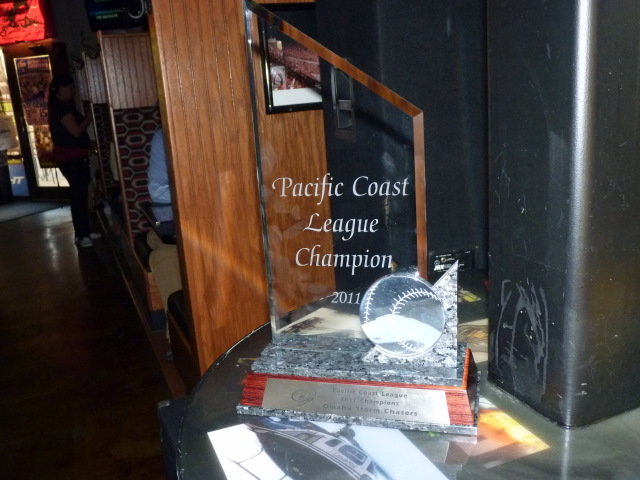
The Omaha Storm Chasers finished off their storybook season by sweeping the Sacramento River Cats in the PCL Championship Series, winning a league championship for the first time since 1990.

Q and A with Clint Robinson

On Monday, before the Chasers worked out at Werner Park for the PCL Championship Series, Clint Robinson spoke with Omaha Baseball 360 about his season.

Omaha wins the PCL American Conference Championship

Kila Ka’aihue hit a two-run walkoff home run in the bottom of the tenth inning Saturday to give the Omaha Storm Chasers the Pacific Coast League American Conference Championship.

Sunday, January 23, 2011

Royals Caravan stops at Children's Hospital & Medical Center

The Royals Caravan made a stop at Children’s Hospital & Medical Center on Thursday. Alex Gordon, Luke Hochevar, Frank White and John Mayberry visited children, bringing smiles to their faces as they chatted with them.

Isabella cuts her eyes at Luke Hochevar
“Who is your favorite team?” one of players asked a 13-year-old boy named Paul.

“The Royals, now,” Paul said.

The players, and former players, stopped by the room of an 11-year-old girl named Kyra. They found out she likes to play soccer.

Michael, a 15-year-old, wanted to talk about football and Hochevar was more than willing, asking him who was going to win this weekend. Michael is a Steelers fan, so that was his pick.

Friday, January 21, 2011

Q & A with Alex Gordon during Royals Caravan stop


The Kansas City Royals Caravan rolled into Omaha on Thursday, making a stop at Children’s Hospital & Medical Center to visit children and then moved on to the Ultimate Baseball Academy where players took questions from fans and signed autographs.

Alex Gordon, Luke Hochevar, Frank White and John Mayberry were on the caravan this year. Mitch Meier was scheduled to be there as well, but was unable to make it due to travel issues. Gordon, Hochevar, and White met with the media at the hospital and you’ll be able to read what they had to say here over the next few days.

Here is the Q & A with Gordon:

Tuesday, January 18, 2011

Gil Meche announces his retirement

Gil Meche in action for Omaha
(Photo: Eldon Lindsay/omahastormchasers.com)
When the Royals signed Gil Meche before the 2007 season to a 5-year/$55 million contract, I wrote a short post for my Royal Reflections blog at the time quoting Jeff Passan who said this about the Meche signing:

“If the Royals were going to give out that amount of years and dollars, why didn’t they just go after A.J. Burnett last season? In Meche, they get a sinkerballer who spent time in the minor leagues two years ago and has found minimal success at the big-league level.”

But Royals fans held their breath and hoped. There’s been a lot of that over the years.

Meche temporarily squashed any concerns when he took the mound on Opening Day 2007 and shut down the Red Sox, giving up just one run in 7.1 innings. 

Friday, December 17, 2010

Moving day at Rosenblatt Stadium

The moving trucks backed up to Rosenblatt Stadium early this morning, ready to transport office furniture, boxes full of desktop knickknacks and decades of memories.

“This is an unbelievable day,” said Rob Crain, assistant general manager of the Omaha Storm Chasers, while sitting in his now empty office. “I came in the office today beeping the horn – all excited because it’s moving day. We’re really excited. We made a lot of memories here over the past 42 years and we look forward to carrying those over into Werner Park and having a great, long term relationship there.”As the Omaha Storm Chasers’ office staff packed for the move to Werner Park in Sarpy County some 15 miles away, they ran across quite a few surprises.

Saturday, December 11, 2010

‘Time in the Minors’ gives fans an intimate view of minor league baseball

All 1,500 players who are drafted each year out of high school or college dream about making it to the major leagues. Sandwiched between the dream and the possible realization of it are injuries, slumps, hot steaks, adjustments or a lack thereof, the mental aspect of the game and low pay. And then there are the uncontrollables – the personnel moves, playing time and timing.

Tony Okun, who grew up in Omaha watching the Omaha Royals play and now lives in Idaho, gives us a glimpse of the entire journey through the eyes of two players who come from different perspectives in his “Time in the Minors” documentary distributed by Landmark Media.

Tony Schrager, a 28-year-old infielder who was born in Omaha, played for Omaha Westside, and went on to play at Rosenblatt Stadium in the 1997 College World Series for Stanford. The Chicago Cubs drafted him in the 6th round in 1998 and sent him to play in A-ball. Schrager got an $87,500 signing bonus, plus $20,000 to finish school and he was paid $850.00 a month in A-ball, minus expenses.

John Drennen, an 18-year-old highly touted outfielder, received a $1 million signing bonus out of high school with the Cleveland Indians after being selected as a sandwich pick in the 2005 draft. He started in rookie ball, making $1,175 per month.

The documentary weaves back and forth as their stories progress during the 2005 and 2006 seasons, taking viewers into the locker room, weight room and family room of each player. Okun interviews their current and former coaches, scouts and teammates. As you watch, the tension builds, making you wonder if either of them will see their dream realized.

“This isn’t a glamorous story,” Okun said in a phone interview. “It’s hard. It shows the challenge that they go through and that’s exactly what I wanted to do. I wanted to just go from A to B and show you what these guys go through. And I hope you walk away from it with a newfound perspective or respect for these kids playing in the minor leagues.”

Okun shows how important timing can be as minor leaguers chase their dream. At one point, just as Schrager is positioned to get a call to the major leagues, he goes into a slump. In another scene, Drennen gets a chance to face Roger Clemens in a minor league game, shortly after Clemens came out of retirement in 2006 to pitch for the Houston Astros. Clemens hung a 2-2 splitter that Drennen hammered over the right field wall.

Eventually, Schrager found himself out of affiliated baseball in an independent league, and you can feel the feel the pressure he is under as he talks about it.

“I wasn’t ready to say that my career was over in affiliated baseball,” Schrager says in the film. “This is really the only way for me to get back in it. Even if I go out here and have a great year, there’s no guarantee. I could have the best year of my career here and there’s no guarantee that somebody’s going to pick me up.”

The DVD is available in two lengths – a 60 minute version or an 85-minute version, the latter of which includes footage Okun shot in Omaha at Rosenblatt Stadium when Albuquerque visited Omaha for a series in 2006. Schrager played for Albuquerque at the time

“It was real special, walking up on those old, slick, metal risers again,” Okun said. “It was bringing back memories from my childhood. I thought it was very special – Tony coming back to his hometown.

“It was great. It was nothing but a wonderful experience. I really enjoyed it. I actually caught a foul ball. I was up with the other videographers and a ball comes screaming up toward me and I caught it. I got a nice ovation from the crowd. It was really funny and I have the ball in a box of stuff I collected while shooting the film.”

The longer version of the film contains portions of a radio interview Schrager did with Mark Nasser, who has been calling Omaha Royals’, now Storm Chasers’, games since 2001. Schrager says during the interview that one of the first things he did after he learned he’d be playing for Albuquerque was to look at the schedule to see if they would be playing in Omaha.

If you are interested in picking up a copy of the DVD, you can find out more by going to the Oh! Show Productions website. Here’s a trailer of the film:

Friday, November 26, 2010

Parraz claimed by Boston; others moving on too

The Omaha Storm Chasers are going to have more than just a new name and a new stadium in 2011. They are also going to have a number of new players.

The Chasers will need to find a new right fielder because Jordan Parraz was claimed on waivers by the Red Sox after being outrighted to Omaha earlier this week.

Parraz was on the 40-man roster prior to that, and with good reason. He put up good numbers (he hit .358 with a .451 OBP in 64 games) in NW Arkansas in 2009 and hopes were high for him in 2010, but he had a less than stellar season for Omaha. He hit .266 with 11 HR and 61 RBIs in 123 games.

At times during the 2010 season, Parraz looked lost at the plate. As Jai Miller began putting up big numbers, he cut into Parraz’s playing time. When the Royals left Parraz off the 40-man roster recently, it became clear that the 26-year-old's 2010 performance was cause for concern in the organization.  

Bryan Bullington, the pitcher of the year for Omaha last season, asked for his unconditional release so he could sign with the Hiroshima Toyo Carp in Japan. The 30-year-old was 8-2 with a 2.82 ERA in 20 games for Omaha in 2010. He struggled in Kansas City, after being called up, going 1-4 with a 6.12 ERA in 13 games.

Anthony Lerew, another standout in Omaha’s 2010 starting rotation, signed a minor league contract with Oakland. The 27-year-old has been pitching in the Venezuelan Winter League where he recently tossed a no-hitter. He was 9-4 with a 2.55 ERA in 22 games (19 starts) for Omaha in 2010. Like Bullington, he struggled after getting the call to Kansas City, going 1-4 with an 8.54 ERA in 6 starts.

Josh Rupe, who spent time as Omaha’s closer in 2010 – picking up 10 saves while going 2-4 with a 2.92 ERA, signed a minor league contract with Baltimore. The 27-year-old also had a hard time making the most of his opportunity when he was called up by Kansas City. He was 0-1 with a 5.59 ERA in 11 relief appearances.

Finally, infielder Ed Lucas, who came out of nowhere to have an incredible season in 2010, signed a minor league contract with Atlanta. He hit .307 with 13 HR and 50 RBIs in just 99 games for Omaha. He has been in the Royals’ system since being drafted by them in the 8th round in 2004.

Gaby Hernandez and Victor Marte were assigned to Omaha this week and will probably start the year with the Chasers in 2011.

Monday, November 22, 2010

Memories are flowing for Steve Rosenblatt

Steve Rosenblatt signs autographs at Rosenblatt in August.
As the Omaha Royals’ 2010 season drew to a close, Steve Rosenblatt continued to frequent the stadium named after his father. He fielded questions from reporters who were wondering what he was feeling as the era of stadiums being named after people rather than corporations was drawing to a close.

One particular night, he told a couple of us he thought the gravity of the situation would hit him as the final seconds of the final UFL game played at the stadium ticked off the clock. That night is coming soon. The UFL Championship Game will be played on Saturday at Rosenblatt and then the stadium will go dark for the final time.

The UFL Championship Game is a new wrinkle. Rosenblatt planned to head home to Phoenix on Friday since the final Omaha Nighthawks game has already been played. But he changed his plane reservations to stay in town for the championship game.

“I really feel, kind of inwardly, that having been there, and having been a bat boy at the first game ever played there, I certainly wanted to be there for the last sporting event,” Rosenblatt said in a phone interview this past weekend. “It’ll rev my memory up a little bit.”

Having his memory revved up has been happening a lot lately. In September, when the Omaha Royals’ played their final game at Rosenblatt, he went down onto the field for one final hit. He told the fans if he hit one that Johnny Rosenblatt would be proud of, he would turn around, give the thumbs up and the fireworks would begin.

So, what was he thinking that night as he stood at the plate?

“It’s over,” Rosenblatt said. “It’ll probably be the last time in my life I ever hit a baseball. Of course, at 72 years old I probably should have stopped about 30 years ago.

“We had a lot of fun that night. It was a great evening. As difficult as it was, I got a big kick out of it because, you know, my daughter did the national anthem and she did a great job – I think she over shone my hitting ability – and we had a lot of Rosenblatt people in town. It was the first time I’ve ever got together with my other three cousins named Rosenblatt – all four of us together. They are of course, Johnny’s nephews. It was a sad but neat evening.”

Tom Kelly was the man who threw batting practice pitches to him that night. Kelly is the grandson of Tommy Kelly, the man who threw the first pitch ever at Rosenblatt in October, 1948 – the night Steve was a batboy in the third base dugout.

“I didn’t want to disappoint the fans. I think I hit a couple halfway decent. But it brought back a lot of memories because I had several at bats there when I was playing many, many years ago when I probably could swing a little better. It was almost like every pitch, I was thinking about something other than hitting the baseball.”

How could he do anything but remember? He’s a walking baseball encyclopedia. He tells one story that connects Rourke Park, the stadium that used to stand on 13th and Vinton before it burned down in 1936, with Municipal Stadium, which would eventually become Rosenblatt Stadium. He says Satchel Paige pitched in both ballparks.

But the memory doesn’t end there.

“In 1951 or 52, the [Kansas City] Monarchs came through here and played a game in the Negro American League,” Rosenblatt said. “I think my dad may have been involved in setting the game up – he was running the stadium at the time. His job was the city commissioner.

“We get to the game. I’m probably 13 or 14 years old and we walk into the stadium and my dad says to me, ‘Steve, you’re upstairs on the PA. You’re doing the public address.’ I said, ‘What?’ So, I’m doing what Bill Jensen [the current PA announcer] does, except I’m 14. So here I go upstairs and pitching for the Monarchs is Satchel Paige.

“He was in the big leagues I think in 48, 49 and 50 with Cleveland. He has this thing called the ‘hesitation pitch’ and he used it on a number of occasions during that game, which was the most memorable thing to me. It was mind boggling to see anybody do what he could do.”

Rosenblatt describes the hesitation pitch in detail.

“Most people in that day – including myself, because I was pitching a little bit at that time – had kind of a rocking chair windup. They’d have the ball in front of them. They’d bring their hands down, come back up over their head, using lots of energy the pitchers today don’t use.

“So, he’d do that and then he’d go up on his right foot and he’d come down on his left foot, but when he came down on his left foot, he didn’t throw. So the batter sees him coming forward and his weight begins to shift because you’ve only got a microsecond and his weight is slightly transferred but Paige still hadn’t thrown the ball yet.

“Then, he’d turn loose about a 92 mph fastball from that position and he’d catch the hitter literally flatfooted. You’d think, ‘How in the world would you get any power on a baseball that way?’ but he had that kind of a whip, lean body that was very flexible.”

The Satchel Paige connection doesn’t end there.

In 1935 or 36, Rosenblatt says that during the AAU semi-pro tournament in Wichita, Johnny Rosenblatt played for the Nebraska team and they went up against a team from North Dakota that Satchel Paige played for at the time.

“My dad gets up to hit against him and Paige gets two strikes on him,” Rosenblatt said. “The catcher threw the ball back to Paige, Paige grabs the ball, walks halfway to home plate and he says to my dad, ‘You won’t see the next one.’”

“He walked back to the mound, made his pitch, Johnny swung and his comment in the Wichita paper was, ‘Never saw it.’”

On September 2, 2010, some 75 years later, Steve Rosenblatt made his way to home plate for what would be the final at bat ever at the stadium.

He attempted a few bunts, then he began to swing. He made contact on a couple and he swung and missed a couple. The crowed urged him on – video cameras running, anticipation building. After making good contact on a ball he pulled toward third base, he figured that was good enough for Johnny, so up went his thumb, and down went the lights.
Friday, November 19, 2010

Q & A with Jerry Cram

You don’t have to dig deep into the Omaha Royals’ record book to find Jerry Cram’s name. The right-hander, who pitched for Omaha from 1969-1972 and 76-81, sits on top of the all-time wins list (61), games pitched (314) and strikeouts (586).  He’s also second all-time in saves (37).

In 15 minor league seasons, he posted a 107-74 record with a 3.26 ERA and 1.27 WHIP. He never got much of a look at the big league level though. In 23 big league appearances spread out over four seasons, he was 0-3 with a 2.98 ERA and a 1.34 WHIP. But he’s a fixture in Omaha Royals’ history.

As Omaha’s 2010 season was winding to a close, I caught up with Cram and had a brief conversation with him at the 1970 Team Championship Dinner at Rosenblatt Stadium.

What do you remember about the 1970 championship season?

We won the championship in ’69. It was my first chance to play in Triple-A. I almost made the big league club that year and then having to come back was like, “Okay, work hard, do this, do that,” but we had such a great bunch of guys and whenever you can win something back to back, no matter where you’re at – it was a great accomplishment.

What do you remember about Rosenblatt Stadium?

Shakey’s Banjo Band played between innings and there’s not going to be too many people who remember that part of it.

But it wasn’t built up. It was just the one section. The ball still kind of flew out of here. Left-handed hitters struggled to hit balls out of here. You could never hit a ball to straightaway centerfield. It was definitely a pitcher’s park, but we played a very, very good brand of baseball.

Jack McKeon [who was the manager at the time] was just talking about how you guys struggled to hit .500 in 1970, and how, after you finally hit that, your team took off. Do you remember that stretch of games where you got to .500 and took off?

Well, there’s been a lot of games since then. I probably don’t remember that stretch. But that’s usually what happens. When a team wins, say 10 games in a row, then it kind of catapults you right on by and you just keep right on going.

Talk about the group of guys you played with in 1970 and the influence they had on your career.

I played with a lot of older guys and I learned a lot of things from them. We didn’t have coaches. We just had McKeon as the manager. We didn’t have a hitting guy. We didn’t have a pitching guy who stayed with us like they have today.

Tuesday, November 16, 2010

Triple-A team is now the Omaha Storm Chasers

Courtesy: Storm Chasers
The Omaha Royals announced their new team name yesterday at the Embassy Suites – La Vista in front of more than 1,000 fans. They are now the Omaha Storm Chasers. The new name was chosen by fans from among the nine most popular options.

“The team name recognizes the importance of weather in the metro area and across the state,” said Martie Cordaro, vice president and general manager of the team. “It also, in a whimsical way, pokes a little fun at the variety of weather we experience here.”

The team will have two new mascots for the 2011 season – Stormy and Vortex. Casey will also be returning. The team will have a new logo and uniforms as well. But it won’t be out with the old and in with the new entirely.
Vortex

Stormy
“We’re still the same front office staff,” Cordaro said. “We’re still going to be the same entertainment option that we have been. We’re only going to do it in a facility that is amenity appropriate for minor league baseball.

“Nine thousand total capacity – 6,500 fixed seats versus the 24,000 that we had. I think that’s the biggest change. Yes, geographic location has changed, but Sarpy County should be commended for keeping Triple-A baseball in the metro because if they didn’t do it, Triple-A baseball wouldn’t be playing anywhere else here.”

With the exception of a three-year period, the team has been known as the Omaha Royals for four decades. One of the biggest challenges in changing the team name is going to be brand identity – especially among people who enjoy the baseball experience while not necessarily following the box scores on a regular basis. The front office seems confident that they are up to the challenge.

“We’re going to do a very good job of making sure that the relationship between Omaha and Kansas City remains constant,” said Alan Stein, president of the Storm Chasers. “We’re going to put a patch on our shoulders. We’re going to do all of the little things with our affiliates’ stamp that we can. We’re going to sell more baseball than what we have in the past.

“Beyond that, we are very comfortable that as the Triple-A club in this market, we’re going to be everywhere with this new brand and when folks get out to the new ballpark and see how great that is, we don’t think there is going to be any issues at all with the transition of the brand.

“Then when you throw on top of that what a good brand this is all by itself – all of the things we’re going to be able to do in schools with kids and math and science and technology and all of the fun play on words that we’ll be able to use with Storm Chasers, and the fact that, according to our research, more people said weather was the one thing they identified themselves with in Omaha [more] than anything else. They said transportation, agriculture, philanthropy and weather. We knew we were on the right track.”

The Storm Chasers will begin play at the newly named Werner Park in Sarpy County on April 15, 2011.

In other news, Bill Jensen, the PA announcer at Rosenblatt Stadium for the past 20 years, will return for the 2011 season for both the Omaha Storm Chasers and the College World Series.

*****
Omaha Storm Chasers' GM Martie Cordaro makes the announcement about the new team name on November 15, 2010: